1. Background and Justification
Soybean (Glycine max L.) A multipurpose species of grain food legume known for its high content of valuable and high-quality protein, oils, and as a superior source of food for both humans and animals [
1]. It undoubtedly has significant global economic and social significance. In the present, it has also become the world's most significant source of vegetable oil. Unlike most other beans, it has 40% protein, compared to meat and eggs' respective protein contents of 20% and 13%. Additionally, it has 20% non-cholesterol oil, and its fortified foods are far more affordable than those from other sources of high-quality protein. It is highly likely to be handled for soy milk, cooking oil, and a variety of other things, such as baby food, to be used directly for dietary needs in the household. Feed made from soybeans is also used in the poultry business. Market demand for soybean grain is frequently strong. The abundant protein content of the crop residues makes them excellent pet food and a wonderful starting point for compost manure. It has the biggest gross output of vegetable oil among all cultivated crops, with a total cultivated area of 117.7 million hectares and a total production of 308.4 million tons, making it a source of edible oil (the second most consumed oil in the world after palm oil)
| [2] | D. Grogan, S. Frolking, D. Wisser, A. Prusevich, and S. Glidden, ‘Global gridded crop harvested area, production, yield, and monthly physical area data circa 2015’, Sci. data, vol. 9, no. 1, p. 15, 2022. |
[2]
. Malnutrition and food insecurity are two of the most pressing issues that developing countries face today.
Producing and consuming more soy would improve the situation (food security) because it provides a balanced diet of calories and protein. Soybean is the most nutrient-dense crop product because its dry seed has the highest protein and oil content of any grain legume (40 to 42 percent protein) and has 18-20 percent oil by dry seed weight. Because of their limited purchasing capacity, they are a highly valued and nutritious source of protein for poor farmers who have less access to animal sources of protein (low purchasing power). Soybean is an optional source of protein for rural families in that it may be used in a variety of home construction projects and the surplus can be sold for money to various buyers, producers, and manufacturers
| [3] | U. Tilahun and A. Bedemo, Farmers’ perceptions and adaptations to climate change through conservation agriculture: the case of guto gida and sasiga districts, western Ethiopia. GRIN Verlag, 2014. |
[3]
.
Numerous other items with a soy base are also utilized directly in human consumption (soymilk, tasty soya, soy yogurt, snacks, soya sauce, protein extract and concentrates, etc.). Soybeans make a significant contribution to the total value added by the agricultural sector in the major producing countries, particularly in Brazil, Argentina, Paraguay, and the United States. Soybeans and their derivative products play a significant role in these countries' overall export revenues.
Only India and Bolivia, which are minor producers, make a sizable profit from the export of soybeans and their derivatives and byproducts
| [4] | P. Thoenes, ‘Soybean International Commodity Profile, Markets and Trade Division Food and Agriculture Organization of the United Nations’, 2014. |
[4]
. Records from 2008 to 2016 show that, despite being a relatively new crop in Ethiopia, soybean production, yield, and area have all increased significantly at rates of 30.8 percent, 45.4 percent, and 11.2 percent annually, reaching 38,166 ha of land to produce 812,420 quintals of soybeans with a national average yield of 21.3 qt/ha
| [5] | L. Cochrane and Y. W. Bekele, ‘Average crop yield (2001–2017) in Ethiopia: Trends at national, regional and zonal levels’, Data Br., vol. 16, p. 1025, 2017. |
[5]
. Due consideration was given to soybean production as an industrial crop in the current five-year plan, GTP II, and it is anticipated that production will rise from 0.72 million quintals in 2015 to 1.2 million quintals by the year 2020 in order to meet market demand by establishing a connection with the business sector and global market
| [6] | I. I. GTP, ‘Ministry of Agriculture and Rural Development Second Growth and Transformation plan’, Addis Ababa, Ethiop., 2015. |
[6]
. Because it is all around adjusted to the nation's lowland to mid-height agro-ecologies, where the vast majority of the potential is found, achieving this target is likely essential for soybean developing parts of the nation, including the Western, South, southwestern, and northwestern parts of the nation, as are the entire low to mid-altitude soybean belt areas of the country. In addition, Ethiopia’s strategic location closer to the world's largest consumers of soybeans and soybean products is also a feature that makes it a great open door for the nation to target soybeans as a potential export commodity and import substitution
| [7] | B. Ayalew, A. Bekele, and Y. Mazengia, ‘Analysis of cost and return of soybean production under small holder farmers in Pawe District, North Western Ethiopia’, J. Nat. Sci. Res., vol. 8, no. 1, pp. 28–34, 2018. |
[7]
.
Even though soy beans are crucial for addressing the country's ongoing issues with food insecurity, little attention has been paid to their production, supply, and export. Harvest, threshing, and product management after harvest all require equal and sufficient attention if small-scale agriculture is to improve its contribution to guaranteeing food security in the nation. One of these labor-intensive, slow-moving operations is threshing. It's critical to limit grain damage during threshing since damaged grain is considerably more vulnerable to insect and fungal assault. Therefore, methods like hitting with sticks or trampling by cattle are not advised because they break and harm grains. Traditional crop threshing is one of the labor-intensive, time-consuming processes that results in grain loss
| [8] | H. Abagisa, T. Tesfaye, and D. Befikadu, ‘Modification and testing of replaceable drum multi-crop thresher’, Int. J. Sci. Basic Appl. Res., vol. 23, no. 1, pp. 242–255, 2015. |
[8]
.
The process of separating seeds or grains from crop heads or pods is known as threshing. The earliest method of threshing was to beat the grains out with sticks. This arduous task was first simplified whereby the grain heads were spread out on a hard surface or ground and oxen were driven over them to trample out the grains from the heads. Threshing is done traditionally by placing the harvested produce on the floor of mud or concrete and beating it with a stick or flail. Other methods include the use of a mortar and pestle to remove the seeds. These methods of threshing, However, because the output is so low, occasionally contaminated, labor-intensive, and time-consuming, these threshing techniques are not convenient enough.
After threshing, soybean grains must be cleaned before being stored or utilized for food. This is because foreign substances in the grain speed up deterioration and cause the grains to be in poor physical condition and quality. Farmers are then forced to perform additional work difficult, ineffective, time-consuming, and expensive work to separate and clean grains from undesired contaminants that would otherwise diminish the quality and value of the crop before storage, marketing, distribution, and further processing
| [9] | S. Benaseer, P. Masilamani, V. A. Albert, M. Govindaraj, P. Selvaraju, and M. Bhaskaran, ‘Impact of harvesting and threshing methods on seed quality-A review’, Agric. Rev., vol. 39, no. 3, pp. 183–192, 2018. |
[9]
. The high-tech mechanical threshing preserves the quality of the finished products by eliminating the labor-intensive local threshing system and minimizing threshing losses
| [10] | T. A. Adekanye, A. B. Osakpamwan, and I. E. Osaivbie, ‘Evaluation of a soybean threshing machine for small scale farmers’, Agric. Eng. Int. CIGR J., vol. 18, no. 2, pp. 426–434, 2016. |
[10]
. Therefore, the objective of this paper is to review the development and performance evaluation of soybean threshers.
2. Review of Literature
2.1. Soybean Threshing
Any program that is intended to produce seeds and attempts to improve the quality of the seeds must include seed processing as a vital component. The grain is separated from the panicles during the threshing process. Rubbing, stripping, impact action, or a mix of these motions are used to carry out the procedure. Manual labor (trampling, beating), animal power, or mechanical threshers can all be used to accomplish the task. In underdeveloped nations, manual threshing is the most common method.
2.2. Threshing Method
Based on the various mechanization technologies employed, the various ways of soybean threshing can be characterized. These include manual threshing, threshing using an animal, and threshing using a machine.
2.2.1. Manual Threshing
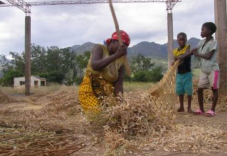
After all the crops have been harvested from the field, threshing is a significant post-harvest activity. Manual threshing is a labor-intensive and slow process. Small quantities of harvest are typically processed by pounding them with a stick or on the ground. This method produces 17–20 kg/hr.
Figure 1. Threshing by hand.
2.2.2. Threshing by Animals
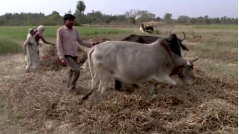
Threshing by animals is a very common method used in villages. A spotless threshing area is used to disperse the harvest. The animals are tied in line one after the other with the help of a strong pole, fixed in the center of the threshing space. Animals move round and round on the harvest and trample them continuously till the grains are completely separated from the straw. One man drives the animals from the back. The output obtained by this method is about 140 kg/hr.
Figure 2. Threshing by animal.
2.2.3. Threshing by Machines
After all the crops have been harvested from the field, threshing is a significant post-harvest activity. High technology is used in mechanical threshing, which helps to maintain the quality of the finished products. It also eliminates the tedium of traditional local threshing systems and lowers threshing losses
| [11] | J. O. OLAOYE, ‘Development of a treadle operated abrasive-cylinder for threshing cowpea’, 2011. |
[11]
.
2.3. Design Needs and Considerations
Maximizing a machine's performance is the primary goal of design. It was shown that the variables affecting soybean threshing efficiency can be divided into two categories: crop characteristics and machine parameters. The design of mechanical systems is influenced by engineering design variables as well. These include choosing the right prime mover, pulley type, power transmission shaft design, key, proper chain drive design, and suitable bearing support selection.
2.3.1. Soybean Physical and Mechanical Properties
Designing and building facilities and equipment for handling, transporting, processing, and storing soybeans as well as determining the quality of soybeans depend on the physical characteristics of the bean. By combining the aerodynamic properties of soybeans with four degrees of moisture content,
| [12] | R. Polat, U. Atay, and C. Saglam, ‘Some physical and aerodynamic properties of soybean.’, 2006. |
[12]
determined various physical characteristics. They claim that physical and aerodynamic properties are important in order to build processing equipment and facilities for sorting, separation, transporting, processing, and storage. The study did not specify the kinds of soybeans that were sampled. However, soybean varieties, according to, Length, breadth, thickness, 1000 seed mass, geometric mean diameter, arithmetic mean diameter, sphericity, porosity, true, and bulk density are the physical characteristics of soybeans that are measured. Aerodynamic characteristics Terminal velocity is a metric that is included in the mechanical characteristics assessed in this study. The coefficient of static friction on glass, galvanized iron, and plywood are three more parameters. The moisture content of soybean samples was determined using the thermal gravimetric technique (103 (2, C))
| [12] | R. Polat, U. Atay, and C. Saglam, ‘Some physical and aerodynamic properties of soybean.’, 2006. |
[12]
. According to reports, the dimensions of soybean including their length, breadth, thickness, 1000 seed mass, sphericity, real density, terminal velocity, and static coefficient of friction (on glass, galvanized iron, and plywood increase linearly as their moisture content rises. With an increase, soybean bulk density and porosity decreased linearly. The physical characteristics of green soybean with pods in relation to the standards for creating sorting tools were assessed by
| [13] | P. Sirisomboon, P. Pornchaloempong, and T. Romphophak, ‘Physical properties of green soybean: criteria for sorting’, J. Food Eng., vol. 79, no. 1, pp. 18–22, 2007. |
[13]
. Glycine max variety AGS 292 was the kind of green bean variety that was measured. In order to build and create suitable machinery, it is necessary to take into account the physical characteristics of green vegetable soybeans, claim
| [13] | P. Sirisomboon, P. Pornchaloempong, and T. Romphophak, ‘Physical properties of green soybean: criteria for sorting’, J. Food Eng., vol. 79, no. 1, pp. 18–22, 2007. |
[13]
. Size, pod weight, projected area, perceived density, and bulk density are some of the physical characteristics. However, mechanical characteristics, namely seed firmness, are one of the metrics examined in this study. Size is measured by calipers for width, length, and thickness, and pod weight is determined using an electronic balance with a sensitivity of 0.01 g. Six replicates of fifty pods from each group were measured. A penetrometer with a maximum force of 1 kgf is used to assess the moisture content and hardness of green soybeans.
Some of the engineering qualities of soybean grains were measured
| [14] | E. Ișİk, ‘Some engineering properties of soybean grains.’, 2007. |
[14]
. The moisture content of soybeans was measured to be between 10.62 and 27.06 percent (d.b.). The types of cultivars measured in this study, which only listed Turkish soybeans, were not explained. Physical factors measured include length, breadth, thickness, sphericity, 1000 grain mass, true density, porosity, and bulk density. Other parameters include arithmetic and geometric mean diameters. According to him, soybean dimensions (length, breadth, thickness, 1000 seed mass, arithmetic mean diameter, geometric mean diameter, and projected area) increased linearly with increasing moisture level. With rising moisture content, soybean properties such as surface area, sphericity, real density, porosity, and terminal velocity increased polynomials. Soybean threshing resistance and bulk density are polynomials reduced with higher moisture content. The static coefficient of friction (rubber, stainless steel, aluminum, glass, MDF, galvanized iron) of soybean increased logarithmically with increased moisture content.
The goal of the study was to investigate some of the physical characteristics of soybean at varying moisture levels. The average length, breadth, thickness, and thousand mass at 7.37 percent moisture were 6.55 mm, 5.56 mm, 4.53 mm, and 103.57 g, respectively (dry basis). The geometric mean diameter increased from 5.44 to 5.57 mm as the moisture content increased from 7.37 to 15.80 percent (db), and the sphericity fluctuated between 0.83 and 0.84. In the same moisture range, the bulk and actual densities decreased from 749.1 to 644.4 kg m-3 and 1250 to 1111.11 kg m-3, respectively, while the corresponding porosity increased from 40.07 to 41.9 percent of repose was observed to rise from 26.35° to 30.96° when moisture content rose from 7.37% to 15.80% (db). As the moisture content rose from 7.37 percent to 15.80 percent, the static coefficient of friction of soybean increased linearly against the surfaces of two structural materials, namely glass and wood (db).
2.3.2. Development Threshing Unit
The study
| [15] | A. Vejasit, ‘A comparison between peg tooth and rasp bar cylinders for soybean threshing using axial flow thresher’, Master Eng. Thesis Agric. Mach. Grad. Sch. Khon Kaen Univ., 1991. |
[15]
compared the performance of the rasp bar and peg-tooth threshing drums of an axial flow thresher for soybean crops. The results indicated that the amount of grain retained on the threshing unit for both cylinders at all cylinder speeds and feed rates was not significantly different.
Most of these researchers focused on a spiked tooth drum thresher study, whereas study on the effect of drum type, drum speed, and feed rate found that the rasp bar drum type reduced the proportions of material other than grain passing through the concave. the frictional impact that occurs on the rasp bar drum beaters, which constitutes the threshing effect, has been neglected with more focus on impact alone.
A threshing unit with a peg-tooth drum was constructed and tested at four different drum speeds, three different feed rates, and three different soybean moisture contents
| [16] | A. Vejasit and V. Salokhe, ‘Studies on machine-crop parameters of an axial flow thresher for threshing soybean’, 2004. |
[16]
. Threshing efficiency ranged from 98 to 100 percent, according to the findings. The amount of grain damaged and lost was less than 1 and 1.5 percent (w.b.) at drum speeds between 600 and 700 rpm, feed rates between 540 and 720 kg/h, and seed moisture values ranging from 14.34 to 22.77 percent. The highest necessary power was 2.29 kW at a seed moisture content of 32.88 percent (w.b.) and a drum speed of 700 rpm. The ideal range for feeding rate and drum speed was found to be 14.34 percent (w.b.) of seed moisture content at 600 to 700 rpm of drum speed
| [10] | T. A. Adekanye, A. B. Osakpamwan, and I. E. Osaivbie, ‘Evaluation of a soybean threshing machine for small scale farmers’, Agric. Eng. Int. CIGR J., vol. 18, no. 2, pp. 426–434, 2016. |
[10]
. A soybean threshing machine that primarily included a feeding mechanism, a threshing unit, a fan, and a power transmission unit was designed, made, and assessed. The thresher was tested at drum speeds of 320, 385, 450, and 515 rpm with crop moisture percentages of 10, 16, and 22 percent (w.b.). According to the performance assessment, the threshing efficiency ranged from 98.96 to 99.88 percent for the range of the variable drum speed of 320 to 515 rpm and from 99.73 to 99.29 percent for the range of the variable moisture content of 10 to 22 percent (w.b.). Furthermore, as the speed increased from 320 to 515 rpm, the cleaning effectiveness decreased from 90.81 to 64.25 percent.
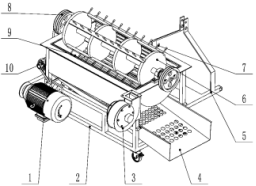
(Xia et al., 2018) was create a unique nail-tooth thresher for pulse crops. The machine was made up of a roller, a nail-tooth structure, a concave screen for stripping, a power source, and a cleaning system. The trial-production prototype's testing results revealed that the concave plate screen with a large spacing, the nail-tooth threshing mechanism, and the threshing roller with a large diameter and low rotation speed are suitable for the threshing of broad beans. The ideal combinations are: roller speed of 400 rpm, feed rate of 1.2 kg/s, and concave tolerance of 54 mm. Testing findings revealed that the designed nail-tooth type wide bean thresher had an impurity content and breakage rate of 1.09 percent and 3.45 percent, respectively. This could considerably increase the efficiency of the pulse crop threshing process.
Figure 3. Nail-tooth thresher for pulse crops.
Table 1. Component part of thresher.
S | Component |
1 | Motor frame |
2 | Cleaning Fan |
3 | grading screen |
4 | -suspension |
5 | Frame |
6 | threshing roller |
7 | nail-tooth, |
8 | driving wheel |
9 | -gravure screen |
10 | vibration mechanism |
The operational elements that influence a short axial-flow soybean threshing unit's performance were studied
| [17] | W. Chansrakoo and S. Chuan-Udom, ‘Factors of operation affecting performance of a short axial-flow soybean threshing unit’, Eng. J., vol. 22, no. 4, pp. 109–120, 2018. |
[17]
. The outcome would be put to use in creating a soybean combine harvester that could be mounted on a tiny tractor. The components of the axial-flow soybean threshing unit include a rotor with a diameter of 0.48 mm and a length of 0.70 m, a peg tooth clearance (PC) of 41.4 mm, a concave clearance (CC) of 20 mm, and an inclination (GI) of 80° for the guiding vane. Grain moisture content (MC), rotor speed (RS), and feed rate were among the variables examined (FR). A short-axis soybean threshing machine is recommended for soybeans with a moisture content of no more than 16% wb and rotor speeds ranging from 10 to 12 m/s, feed rates should not, however, exceed 150 kg/h.
A brand-new rubbing threshing machine was developed, built, and assessed. Its performance was examined and theoretical and practical comparisons made. An electric motor, inverter, husking roller, mechanical jack, belt, and other components go into its construction. The dimensions of this built-in machine are 300 mm in width, 100 mm in working height, 110 to 210 rpm-1 speed range, and 2 hp maximum power. Two goods were put through the practical test (soybean and mung bean). The moisture content ranges from 12 to 17 percent, the speed ranges from 110 to 170 r min-1, and the distance between the drum and the concave ranges from seven to eight millimeters for soybeans and six to eight millimeters for mung beans, respectively. The output indicated that the machine could process 28.506 kg of soybeans and 29.079 kg of mung beans per hour, respectively. The machine's greatest efficiency, which is connected to the mung bean and was attained at a speed of 170 rpm and a distance of 7 mm, was 94.72 percent. The best separation and loss efficiency for mung bean and soybean were 93.00 percent and 1.66 percent, respectively, at a speed of 170 rpm and a distance of 7 mm. In the mung bean test, the best germination efficiency was 95.53 percent, which was accomplished at a distance of 7 mm and a speed of 110 rpm-1.
(Aluko et al. 2020) The performance of a motorized legume thresher was assessed to establish the optimal parameter combinations for the maximum separation efficiency. The thresher was then rebuilt to use the coefficient of friction to separate grains from contaminants. A randomized design with three batch weights (BW) of 100, 150, and 200 g, four surfaces (S), mild steel, plywood, rubber carpet, and rug, two impurity levels (I), and the varieties of cowpea (Vigna unguiculata) IT84S-2242 and soybean (Glycine max L) 1448-2E were used to conduct the study. Sorghum seeds were added as an extra contaminant to each test sample at a rate of 10% of the batch weight. The results revealed that the cleaning effectiveness of the soybean samples ranged from 90 to 63.28%, and the threshing efficiency ranged from 87 to 97%, with an average low damage of 0.78 percent from utilizing the carpet surface. With an average loss of 2.60 percent, the threshing and cleaning efficiencies for cowpeas were 97.44 percent and 97.16 percent, respectively. The 100 g batch weight employing carpet surface was the ideal combination of batch weight, surface, and impurity level to achieve cleaning efficiency, threshing efficiency, minimal grain damage, and low grain losses. It was concluded that the thresher's separation efficiency might be improved by utilizing the coefficient of friction; this would help the development of suitable technologies for processing legumes.
2.4. Performance Evaluation of Soybean Thresher
Machine performance was evaluated with respect to the machine capacity, threshing efficiency, percentage of kernel damage, and fuel consumption by the following equations.
Threshing efficiency(1)
Percentage ofmechanical damage (Md%) =100(2)
Cleaning efficiency (Ce)=100(3)
Output capacity (0(4)
Assessed the modified spike tooth thresher's performance. Concave clearing had a percentage of unthreshed soybean of 16.98%, a percentage of mechanically damaged seed of 8.625%, blown seed of 23.403kg, and high seed loss of 44.241kg, according to the machine's output statistics
| [20] | A. Sessiz, T. Koyuncu, and Y. Pinar, ‘Soybean threshing efficiency and power consumption for different concave materials’, Ama, Agric. Mech. Asia, Africa Lat. Am., vol. 38, no. 3, p. 56, 2007. |
[20]
. The mean threshing efficiency (83.022) and cleaning efficiency (94.175) were also quite high. However, the trends of concave clearance and moisture content are in contradiction to those of cylinder speed. In contrast to one another were the percentages of unthreshed (83.212%) and mechanical damage (16.792%). The efficiency of the cleaning (23.321) and threshing (44.4108) processes was also subpar. Correlations between cylinder speed and machine output revealed increased tendencies for blown seed, percentage of damaged seed, and seed loss.
The effectiveness of the multi-crop threshing machine was examined for millet and soybean crops
| [18] | N. H. Muna, U. S. Muhammed, A. M. El-Okente, and M. Isiaka, ‘Development and Validation of Threshing Efficiency Mathematical and Optimization Model for Spike-Tooth Cereal Threshers’, Int. J. Eng. Res. Dev., vol. 12, no. 11, pp. 50–60, 2016. |
[18]
. Different crop moisture concentrations, cylinder speeds, and feeding rates were used to assess the machine. The findings showed that throughput capacity is directly correlated with speed and feeding rate but inversely correlated with moisture content; threshing efficiency is directly correlated with speed but inversely correlated with feeding rate and moisture content; cleaning efficiency is directly correlated with speed but inversely correlated with feeding rate and moisture content; and scattered grain loss is directly correlated with speed but inversely correlated with feed rate.
Examined the impact of machine-crop variables on the functionality of an axial flow thresher for threshing soybeans with four levels of drum speeds (400, 500, 600, and 700 rpm), equivalent to peripheral velocities of 8.80, 10.99, 13.19, and 15.39 ms
-1, respectively; three levels of feed rates (360, 540, and 720 kg (plant) h
-1; and three levels of moisture content (32.88, 22.77%)
| [16] | A. Vejasit and V. Salokhe, ‘Studies on machine-crop parameters of an axial flow thresher for threshing soybean’, 2004. |
[16]
. According to the test findings, the threshing efficiency ranged from 98 percent to 100 percent. When using a 600-rpm cylinder speed and a 540 kg (plant) per hour feed rate with a 14.34% seed moisture content, the damaged grain rate and grain loss rate are less than 1%, while when using a 700-rpm cylinder speed and a 720 kg (plant) per hour feed rate with a 22.84% seed moisture content, it is less than 1.5%. (w.b.) At 14.3% moisture content, cylinder speeds of 600 to 700 rpm (13.2 to 15.4 ms
-1) and a feed rate of 720 kg (plant) h
-1 were the optimal values.
modified an existing institute (IAR) soybean thresher to achieve the best performance at 850 rpm cylinder speed, 30 kg/h feed rate, and Samsoy-2 variety at 10% grain moisture content
| [16] | A. Vejasit and V. Salokhe, ‘Studies on machine-crop parameters of an axial flow thresher for threshing soybean’, 2004. |
[16]
. Furthermore, 96 percent threshing efficiency, 2.86 percent mechanical grain damage, and 97 percent cleaning efficiency were determined based on his findings. Dispersion loss is 2.86 percent with a throughput capacity of 33 kg/hr.
Constructed, tested, and assessed a soybean crusher
| [19] | O. Adeyeye et al., ‘Construction and evaluation of soybeans thresher’, African J. Agric. Res., vol. 14, no. 21, pp. 921–927, 2019. |
[19]
. The hopper, threshing unit, shaker, cleaning unit, and seed outlet make up the machine. The sample utilized had a final moisture content of around 15%. After being weighed, the sample was fed into the device. The outcome indicates that the capacity and threshing efficiencies are 74% and 65.9 kg/h, respectively. The machine's manufacturing cost was significantly lower than that of the imported soybean thresher since all of the materials were found locally.
PVC, rubber, chromium, and steel plate were the four concave types investigated for soybean threshing efficiency and power consumption with three feed rates (360, 720, and 1,080 kg h
-1) and five beater peripheral speeds (7.95, 9.1010.54, 12.16, and 14.66 ms
-1)
| [20] | A. Sessiz, T. Koyuncu, and Y. Pinar, ‘Soybean threshing efficiency and power consumption for different concave materials’, Ama, Agric. Mech. Asia, Africa Lat. Am., vol. 38, no. 3, p. 56, 2007. |
[20]
. They came to the conclusion that as feed rate was raised, threshing efficiency declined, and that drum peripheral velocity had a considerable positive impact on threshing efficiency. The chromium kind of beater had the best threshing efficiency, followed by PVC, sheet iron, and rubber.
Analyzed the effects of impact velocities (IV), number of impact loadings (NL), and duration (T) on the percentage of seed damage and percentage of germination loss in soybean seeds
| [21] | A. Goli, J. Khazaei, M. Taheri, A. Khojamli, and A. Sedaghat, ‘Effect of mechanical damage on soybean germination’, Int. Acad. J. Sci. Eng, vol. 3, no. 10, pp. 48–58, 2016. |
[21]
. Increases in the impact velocities from 12.4 to 22 m/s (IV1=12.4, IV2=16, IV3=22 ms-1), the number of impact loadings from 1 to 3 (NL1: one brunt, NL2: two brunts, and NL3: three brunts), and the time to three months (T1: when impact loading to seed, T2: after 45 days, and T3: after 3 months) led to increases in the percentage of seed damage.
Designed was, made, and its effectiveness as a blower-powered soybean paddle thresher was examined
| [22] | P. Yamba, E. A. Larson, Z. Issaka, and A. Akayeti, ‘Design, manufacture and performance evaluation of a soybean paddle thresher with a blower’, life, vol. 7, no. 8, 2017. |
[22]
. In accordance with the results, a combination of dry and wet sample mixtures fed at a rate of 25 kg produced a maximum threshing capacity of 96 kg/hr, a maximum threshing efficiency of 98.6%, and a minimum grain damage of 3.5 percent.
The current study demonstrated a link between high cleaning and threshing efficiency and minimal seed loss, blown seed, and mechanically damaged seeds that revealed divergent associations with the thresher's parameters (cylinder speed, concave clearance, and moisture content). Similar to this, it was shown that threshing efficiency rose as cylinder size increased
| [23] | A. K. Zaalouk, ‘Evaluation of local machine performance for threshing bean’, Misr J. Agric. Eng., vol. 26, no. 4, pp. 1696–1709, 2009. |
[23]
. However, compared to the current study, there was significantly reduced seed damage and un-threshed seed. In comparison to the maximum of 83.776 m/s in the current study, he utilized 15.38 m/s. This supports the accuracy of the output models for the moisture content thresher. The finding of the present study increasing threshing efficiency correlated with cylinder speed and concave clearance.





 Share This Article
 Twitter
 Linked In
 Facebook
 Copy
Copy Download